
Hatsumode in Tokyo 2027: How to Skip the Midnight Queue
By Atsushi — host at Bon House in Kanamachi, Katsushika ward. I've run Bon House since 2022 and hosted 300+ guest groups.
Meiji Jingu in Tokyo is Japan's busiest hatsumode shrine: more than 3 million visitors over January 1–3, and after midnight the wait to reach the offering box runs around two hours. Shibamata Taishakuten, in east Tokyo, takes 200,000 to 250,000 over the same three days, and at 7am on New Year's Day it sits in the gap between its two rushes.
Both count as hatsumode, the first shrine or temple visit of the year. Only one of them leaves you with the rest of your first day in Japan.
Kanamachi, where Bon House is, sits one train stop from Shibamata. Every winter the question from guests is the same: midnight at Meiji Jingu, or something closer? This guide is my answer, plus how to do the two famous ones without losing a day to the queue.
Hatsumode in Tokyo: Crowds and Quiet Times
| Place | Visitors, Jan 1–3 | From Kanamachi | Quietest window |
|---|---|---|---|
| Meiji Jingu | 3 million+ | ~40 min | Jan 2–3, after 6:40 opening |
| Sensoji | 2.8–3 million | 25–30 min | Jan 1, 6:30–8:00 |
| Shibamata Taishakuten | 200,000–250,000 | 1 stop, 2–3 min | Jan 1, 2:00–9:00 |
Visitor numbers are typical-year estimates from Japanese travel sites. The police stopped publishing official counts in 2009.
Hatsumode runs through the first three days of January, the sanganichi, and nothing says it has to happen at midnight. In 2027, January 1 falls on a Friday, so the 2nd and 3rd are a weekend and expect heavier daytime crowds on those two days than in a year when they fall midweek.
Shibamata Taishakuten: The Quiet Hatsumode Near Kanamachi
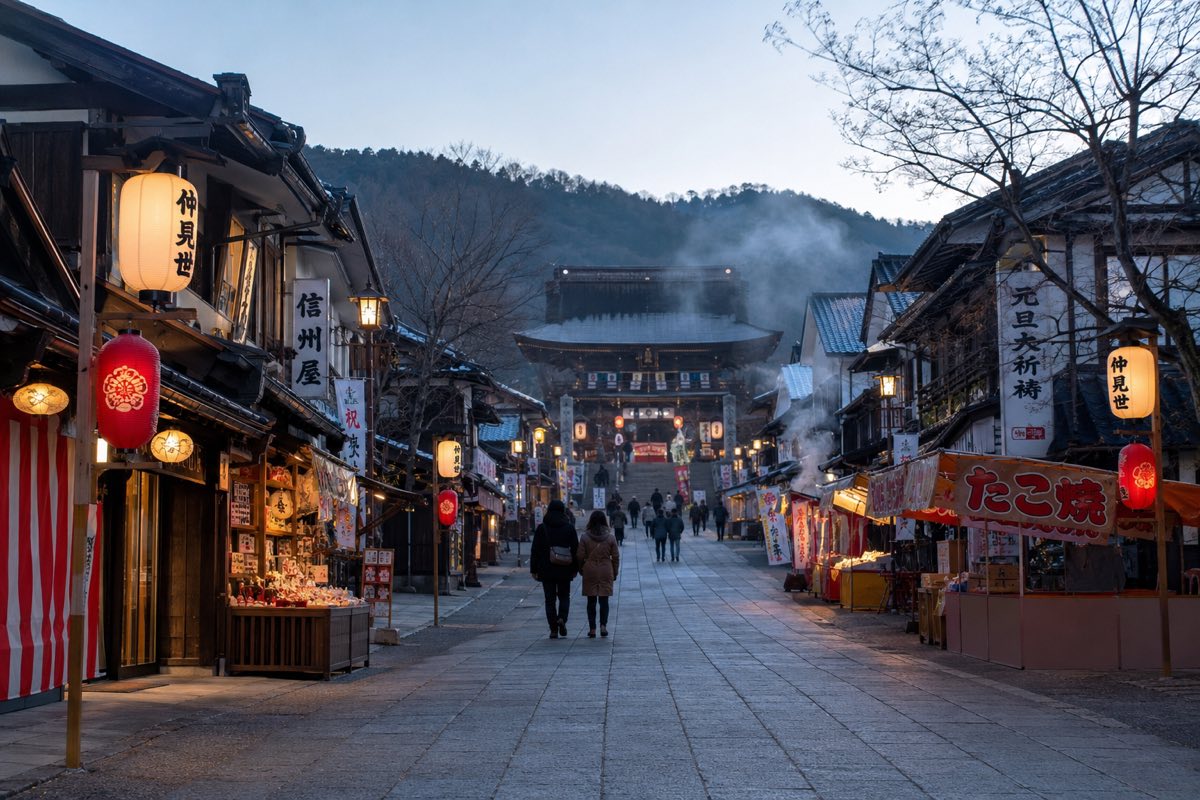
Shibamata Taishakuten (formally Daikyoji) is a Nichiren temple founded in 1629, known across Japan as the home ground of the Otoko wa Tsurai yo film series. It draws a real crowd at New Year, but less than a tenth of Meiji Jingu's.
The crowd comes in two waves. The first runs from about 23:30 on December 31 to 1:30 on January 1, for the bell and the first prayers. The second runs from about 9:00 to 16:00 on each of the three days. Between those, from around 2:00 to 9:00 on January 1, the grounds thin right out. Late afternoon after 16:00 is the other calm patch.
7am on January 1 is the slot I recommend to guests. It's light by then (sunrise is around 6:50), the approach street is waking up, and you're back in time for breakfast before the second wave arrives.
The sando, the 200-metre approach lane from Shibamata station to the temple gate, is the other reason to come. It's a preserved street of wooden shopfronts selling kusa dango and senbei, and New Year is its biggest week. Some shops don't open until mid-morning, so a 7am visit gets you the temple first and the snacks on the way back. Our Shibamata travel guide covers what to eat there the rest of the year.
From Kanamachi it's one stop on the Keisei Kanamachi Line: 2–3 minutes and ¥146 by IC card. Last New Year, Keisei added extra Kanamachi Line trains on January 1–3, running every 10–12 minutes. You'll need a Suica or PASMO, because Keisei doesn't take contactless bank cards at the gates. If you'd rather walk, it's 25 to 30 minutes, and the route near the Edogawa River is the pleasant one.
Sensoji Hatsumode in Asakusa: Go at Dawn on January 1
If you want a large, famous temple, Sensoji is the one to do from east Tokyo. It takes 2.8 to 3 million visitors across the three days, but the grounds are wide and the Nakamise approach keeps people moving, so the crowd feels less stuck than at Meiji Jingu.
Skip midnight here too. The peaks on January 1 are 0:00–3:00 and 11:00–15:00. Come between 6:30 and 8:00 instead, or after 17:00 on the 2nd or 3rd. Some of the people who came for the midnight bell stay on into the early morning, so dawn is calmer, not empty.
From Kanamachi, take the JR Joban Line to Kita-Senju and change to the Tsukuba Express for two stops to Asakusa: 25 to 30 minutes in all. Our Sensoji guide covers the layout and the etiquette in more detail.
Meiji Jingu Hatsumode Without the Midnight Queue
Meiji Jingu keeps its gates open through the night from December 31 into January 1, and that night is when the two-hour queue forms. The daytime peak on January 1 runs roughly 11:00 to 15:00.
The calmer option is the first hour after opening on the 2nd or 3rd. For the 2026 New Year the gates opened at 6:40 and closed at 18:30 on those two days. The 2027 hours come out in late December. From Kanamachi, Joban Line local trains run through onto the Tokyo Metro Chiyoda Line, so you can ride to Meiji-jingumae (Harajuku) in about 40 minutes.
If you go at midnight anyway, plan the trip home first. For the 2025–26 New Year, JR East ran all-night trains on six lines, including the Yamanote and the Chuo-Sobu local. The Joban Line wasn't one of them, and Tokyo Metro didn't run all night. The way back to Kanamachi was the Yamanote to Nippori, then Keisei's all-night locals via Keisei Takasago, at 20 to 50 minute intervals. The 2026–27 plans are usually announced in early December, and a train app will show them once they're out.
Hatsumode Etiquette: Shrine vs Temple
The ritual is short, and nobody minds if you're clumsy about it.
- Bow once at the gate before entering. Walk to the side of the central path, not down the middle.
- At the water basin, rinse your left hand, then your right, then pour a little into your left hand to rinse your mouth. Don't drink from the ladle. Some places have suspended this, so copy whoever is in front of you.
- At the offering box, toss a coin. A ¥5 coin is traditional, because go-en sounds like "good relationship." Nobody checks.
- At a shrine such as Meiji Jingu: bow twice, clap twice, make your wish, bow once. At a temple such as Taishakuten or Sensoji: no clapping. Press your palms together, make your wish, and bow.
- Afterwards, buy an omikuji fortune. If it's a bad one, tie it to the rack provided and leave it there.
The shrine-versus-temple clapping rule is the one thing worth remembering. Clapping at a temple is the giveaway that you're new to this.
What's Open in Tokyo Over New Year, January 1–3
This catches people out, and it disrupts a trip more than the queues do.
Closed or reduced: - Most independent restaurants, from December 31 until January 3 or later - Rikugien, Koishikawa Korakuen and the other metropolitan gardens, December 29 to January 1 (they reopened for the New Year on January 2–3 last season) - Many small shops and neighbourhood shopping streets - Post offices and banks
Open: - Convenience stores, almost all of them, throughout - Major department stores, usually from January 2, with fukubukuro lucky bags - Chain restaurants, family restaurants and most ramen chains - Trains, on weekend-and-holiday timetables for most of the holiday
Supermarkets are the trap. Maruetsu, about 100 m from Kanamachi station, is open 24 hours the rest of the year, but in recent years the chain has shortened its hours on December 31 and closed most branches on January 1. Check the notice at the door in late December, and do the big shop on December 30, before the shelves are cleared of New Year food on the 31st.
This is the week a fridge, microwave and kettle earn their keep. Bon House has no kitchen, but with restaurants shut on January 1 and 2, a fridge stocked on December 30 means hot bento and cup soba instead of convenience-store onigiri three meals running. If you want a New Year base one stop from Taishakuten with those basics in the room, see the room and check New Year availability.
New Year in Tokyo from Kanamachi: A Typical Three Days
Here's how it usually goes for a family of four staying in Kanamachi over the New Year.
December 30. A stock-up run at Maruetsu: bento, fruit, bread for two breakfasts, drinks. All of it goes in the fridge.
December 31. Toshikoshi soba for dinner, either at a local soba shop before it closes or as a cup from the convenience store, made with the room's kettle. Taishakuten rings the joya no kane bell from midnight, but only the 108 people who signed up in advance get to strike it. With children who need to be up at 6:30, the family skips it and goes to bed.
January 1, 7:00. A 7–10 minute walk to Keisei Kanamachi, one stop to Shibamata, and the temple before 8:00. Dango from the sando on the way back if the shops are open, and home by 9:30. The afternoon is for resting or a walk along the Edogawa, since the gardens are still shut.
January 2. Sensoji early, or a department store for fukubukuro. Both are busy in a normal, manageable way. The metropolitan gardens usually reopen today.
January 3. Meiji Jingu right after the gates open, for the family member who wants the famous one. Or Mizumoto Park, which is open, free, quiet and full of wintering waterbirds in January.
That's three temples or shrines in three days, all in the quieter windows, and nobody standing in Harajuku at 2am. If those dates suit you, see the room and book your New Year stay. For more of the area, see our Kanamachi guide and day trips from Kanamachi.
Hatsumode in Tokyo: Frequently Asked Questions
How long does the hatsumode season last?
Any first visit in the first week of January counts. In the Tokyo area, New Year decorations stay up until January 7 (matsu no uchi), and shrines keep their New Year charm stalls running through that week.
Is Tokyo worth visiting over New Year?
Worth it if you want the shrine visits, the fukubukuro sales, and a Tokyo where traffic thins out for three days. Not worth it if your plans depend on restaurants and museums. Many museums close for several days around January 1, and independent restaurants often stay shut until the 4th. Mid-January gets you the city with everything open.
Can non-Japanese people do hatsumode?
Yes, and nobody will think it odd. You don't need to be Shinto or Buddhist to pray, buy an omamori charm or draw a fortune. Staff at the big shrines and temples deal with first-time visitors all through the New Year.
How cold is Tokyo at dawn on January 1?
Close to freezing. The average January low in Tokyo is about 1°C, and you'll be standing still outdoors. Wear a hat, gloves and a warm layer under your coat, and carry a few ¥5 coins in a pocket you can reach with gloves on.
Last updated: October 2026. Visitor figures are typical-year estimates, not official counts. Opening hours and New Year train plans are from the 2025–26 season; confirm the 2026–27 details with each temple, shrine and railway in December.